
India’s Overburdened Courts: A Crisis That Demands Creative Solutions
Around 50 million. That is roughly how many cases are pending in Indian courts at any given moment. Some estimates put it higher. It is a number that gets cited frequently in legal reform discussions, nodded at solemnly, and then mostly left unaddressed. Because the honest answer to “how do you fix a 50-million-case backlog” is that there is no single fix. You have to reduce inflows, speed up processes, and find alternative paths for disputes that do not actually need a courtroom.
ODR is one of those alternative paths. Combined with the growing normalisation of virtual hearings, it offers something India urgently needs: a way to resolve certain categories of disputes faster, cheaper, and without adding to the court queue. And for the startup ecosystem specifically, the stakes in getting this right are particularly high.
What Virtual Hearings Have Changed
When the pandemic shut physical courts down in early 2020, there was genuine panic in the legal community. How do you conduct hearings without a courtroom? How do you examine witnesses? How do you submit physical documents? The answer, it turned out, was: through a screen, with varying degrees of awkwardness.
Video hearings happened. Evidence was presented. Arguments were made. Judgments were delivered. It was not always smooth, and many practitioners had serious reservations about whether the process was fair and technically reliable. But it worked, in the fundamental sense that legal proceedings continued when they might otherwise have stopped entirely.
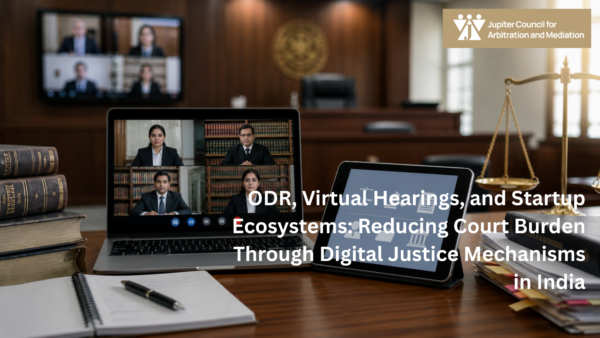
What that experiment revealed was important. Physical presence in the same room is not always necessary for effective dispute resolution. For a large category of cases, particularly those involving document review, contractual interpretation, and commercial claims, parties can participate meaningfully through video without being in the same room or even the same city. ODR platforms have built on this insight, creating structured digital environments specifically designed for dispute resolution rather than adapted from general-purpose video software.
Startups and the Specific Need for ODR
India’s startup ecosystem is genuinely impressive. Thousands of new companies each year, significant venture investment, and a growing cohort of founders building across diverse sectors. But with growth comes complexity, and with complexity comes conflict.
Startup disputes have a particular character. They tend to be urgent in a way that corporate disputes between established companies are not. When a startup’s co-founder relationship breaks down, or a key vendor does not deliver, or an investor disputes the terms of a shareholder agreement, the company is often in a fragile enough state that the dispute itself can be an existential threat. Time is not just money in a startup context; it is survival.
Traditional litigation is catastrophically ill-suited to this reality. A case filed today might not be heard substantively for two or three years. By that time, the startup may not exist. The founders may have moved on. The factual context may have changed so completely that the original dispute is barely recognisable.
ODR offers startups something they genuinely need: speed. A structured online mediation or arbitration process that resolves a dispute in four to eight weeks is not just faster than going to court. It is a qualitatively different experience that allows the parties to either resolve the issue and move forward together or separate cleanly and get on with their lives.
ODR as a Tool for Reducing Court Burden
From a broader systemic perspective, ODR’s most compelling value proposition is not convenience. It is a diversion. If a significant share of commercial and civil disputes can be resolved through ODR before they reach the courts, the resulting reduction in caseload could meaningfully impact the backlog.
This requires being realistic about which disputes are suitable for diversion. Complex constitutional matters, serious criminal cases, and disputes involving questions of law that need judicial interpretation belong in courts. But the majority of civil and commercial disputes are essentially factual questions. Who owed what to whom? Was the contract breached? What does this clause mean in context? For these disputes, a trained mediator or arbitrator working through an ODR platform can often reach a fair outcome just as well as a judge, and in a fraction of the time.
India’s Niti Aayog identified this in its 2021 ODR policy plan, explicitly calling for dispute diversion as a strategy for judicial relief. Several state-level initiatives have since experimented with court-annexed ODR programs, where parties to eligible disputes are directed to ODR platforms before their cases are formally admitted. Early results have been encouraging: higher settlement rates, faster resolution, and parties who report greater satisfaction with the process than those who went through traditional litigation.
The Infrastructure Gap and How to Bridge It
It would be easy to write a cheerful blog about how ODR is going to transform Indian justice and leave out the uncomfortable parts. The uncomfortable part is that ODR, as currently deployed, reaches a relatively small and relatively privileged segment of the population.
A startup founder in Bangalore with a good laptop and a reliable internet connection will find ODR platforms intuitive and accessible. A small trader in a tier-3 city disputing a supply chain payment, who has limited digital literacy and patchy internet access, will face real barriers. If ODR is to fulfil its promise of widening access to justice rather than just making things more convenient for those who already have access, it needs to be designed with the harder cases in mind.
This means multilingual interfaces. It means simplified user journeys that do not assume legal knowledge. It means human support at the edges, people who can help parties navigate the platform without taking over the process. Some Indian ODR providers are working on this. More needs to happen.
Looking Forward: A Digitally Just India
The case for ODR in India is not that it will replace courts or make disputes disappear. It is that the current system is not working for enough people, and ODR is a meaningful part of the solution.
For startups, the benefit is clear: faster resolution, lower cost, and less distraction from building. For the court system, the benefit is a reduced inflow of cases that do not need to be there. For the broader economy, the benefit is a more trustworthy commercial environment where disputes can be resolved without years of uncertainty.
None of this happens automatically. It requires investment in platforms, awareness campaigns, legal framework development, and honest evaluation of what is working and what is not. India has the talent and the technology to build this well. The question is whether the commitment will be sustained long enough to see the results.