
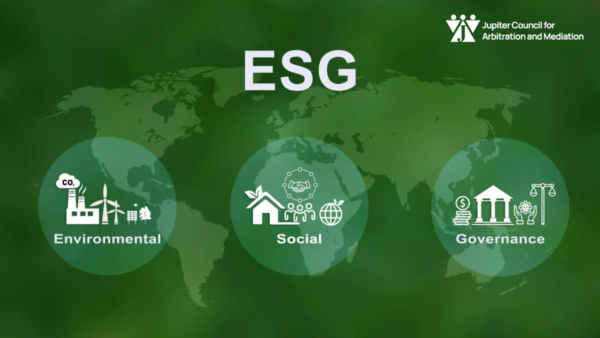
ESG is reshaping how businesses operate and how investors make decisions. When ESG commitments break down, someone has to sort out the mess. Green arbitration may be the best tool we have.
ESG Has Moved from Boardroom to Courtroom
A few years back, when ESG came up in a conversation, eyes would glaze over a little. It felt like consultant speak. Something for multinational corporations and socially conscious fund managers to talk about at conferences. It did not feel like something that would show up in a dispute resolution context.
That has changed rather dramatically. In 2026, Environmental, Social, and Governance considerations are embedded in credit agreements, supply chain contracts, public procurement norms, and stock exchange listing requirements. Indian companies are subject to Business Responsibility and Sustainability Reporting requirements under SEBI regulations. Foreign institutional investors routinely include ESG covenants in their investment agreements. Green bonds are being issued across sectors, from solar power to sustainable agriculture.
When those covenants get violated, when ESG commitments turn out to be overstated or outright false, when a green bond issuer quietly diverts funds to purposes that have nothing to do with sustainability, disputes arise. And these disputes need to go somewhere.
A New Category of Commercial Conflict
ESG disputes are genuinely different from standard commercial conflicts. They involve a mix of legal, technical, and scientific questions that most courts are not well-equipped to handle. A case involving contested carbon credit calculations requires someone who understands both contract law and greenhouse gas accounting standards. A dispute over whether a company’s supply chain labour practices violated social covenants requires knowledge of international labour norms as much as it requires legal analysis.
The categories are also broad. Greenwashing claims, where investors allege they were misled about the environmental credentials of a product or fund. Supply chain disputes involving allegations of forced labour or environmental damage by a subcontractor. Governance disputes triggered by a board’s failure to implement agreed ESG policies. Carbon credit agreement disputes. Investor exits triggered by ESG covenant breaches.
India is generating its own versions of all of these. As the country scales up renewable energy, pursues net-zero targets, and attracts more ESG-conscious foreign capital, the volume and complexity of ESG disputes are going to grow substantially.
What Green Arbitration Actually Means
Green arbitration is a term that covers two different but related ideas. The first is about the substance of disputes: using arbitration as the forum for resolving conflicts that have an ESG character. The second is about the process: making sure that the arbitration proceeding itself does not have an unnecessary environmental cost.
On the substantive side, arbitration has real advantages over litigation for ESG disputes. Parties can appoint arbitrators with specific expertise in environmental law, climate science, sustainability reporting, or corporate governance. Proceedings can be kept confidential, which matters when sensitive environmental compliance data is involved. Specialist procedural rules can be developed to handle the unique evidentiary needs of ESG cases, including the appointment of technical experts alongside legal arbitrators.
On the procedural side, the observation is a straightforward one. If an arbitration involves flying three arbitrators from different cities or countries, couriering physical document bundles across jurisdictions, and booking a hotel conference room for a week of hearings, the carbon footprint of that process is not trivial. For a proceeding designed to resolve an environmental dispute, there is an obvious irony there. Green arbitration tries to close that gap.
The Green Pledge and What It Asks
The Campaign for Greener Arbitrations has been building momentum in the international legal community since around 2019. It introduced the Green Pledge, a voluntary set of commitments that arbitration institutions, law firms, arbitrators, and parties can sign up to. At its core, the Pledge asks signatories to reduce the environmental impact of arbitration proceedings wherever possible.
In practical terms, this means holding virtual hearings as the default rather than the exception. It means working with digital document bundles rather than couriering printed sets to multiple locations. It means avoiding unnecessary international travel by having counsel and arbitrators participate remotely where the case does not genuinely require in-person presence. It means tracking and offsetting the carbon emissions that the proceedings generate.
Major international institutions have taken this seriously. The ICC has published sustainability guidelines. The LCIA and SIAC have followed suit. Dozens of leading law firms globally have signed the Pledge. The argument has been made and largely accepted: there is no reason why rigorous legal proceedings cannot also be environmentally responsible ones.
Where India Currently Sits
India’s arbitral institutions are in an interesting position. During the pandemic, the shift to virtual hearings happened out of necessity and worked reasonably well. The technology was available. Lawyers and arbitrators adapted. Cases continued moving. But when restrictions were lifted, there was a fairly strong pullback towards in-person proceedings. The pandemic-era practices did not get institutionalised.
Formal adoption of green arbitration principles by Indian institutions remains largely aspirational. There is no Indian institution that has formally adopted a sustainability charter for its proceedings. No published environmental impact reporting for cases administered. No default paperless protocol for document production.
This is an opportunity waiting to be taken. India already has the ODR infrastructure in development. An ODR-based arbitration is, by its nature, entirely online. No travel costs. No paper. No physical venue. The environmental case for deepening ODR integration within institutional arbitration is already being made by the infrastructure itself.
What Indian ESG Disputes Look Like
To make this concrete, consider a couple of scenarios that are realistic in the Indian context. A renewable energy developer in Rajasthan issues green bonds and raises several hundred crores from institutional investors. Some portion of those funds quietly gets redirected to cover general operational costs rather than the specified solar projects. Investors discover this discrepancy through a third-party audit. They have a claim for misrepresentation and breach of the green bond framework. This is a dispute that requires expertise in securities law, environmental certification standards, and the specific covenants of the bond documentation.
Or consider an apparel exporter in Tirupur whose supply chain audit reveals that a third-tier sub-contractor was found employing workers below legal working age. The European retailer that the exporter supplies to has strict social compliance requirements in its vendor agreements. The retailer terminates. The exporter disputes the termination on the grounds that the violation occurred three supply chain layers down and was not within their direct control. This is an ESG dispute with a genuine legal and factual complexity that a specialist arbitrator can handle far better than a generalist civil court.
What Indian Institutions Should Do Now
The path forward for Indian arbitration institutions on green arbitration is not particularly complicated. It requires commitment more than it requires innovation.
Forming a dedicated ESG disputes panel is a good starting point. This means identifying and empanelling arbitrators who have genuine, verifiable expertise in environmental law, climate finance, sustainability reporting, and ESG governance. Not just general commercial lawyers, but specialists.
Publishing a formal sustainability charter for proceedings is the next step. Setting defaults: virtual hearings unless there is a specific, stated reason for in-person; digital document submission only; carbon footprint tracking per case. These are achievable with existing technology.
The Green Pledge is open for signature. India’s institutions have been modernising rapidly across many dimensions. Becoming early movers on green arbitration would be both principled and strategically smart, particularly as ESG-conscious foreign investors continue to look at India as a destination.